How Fast Were You Skiing? Understanding Ski Speed
How Fast Do Skiers Actually Go?
Most skiers are genuinely surprised the first time they check their speed data. What feels like a leisurely cruise down a groomed blue run often turns out to be 50 km/h or more — well above the speed limit in most suburban streets. Here’s a rough breakdown of typical skiing speeds across skill levels:
- Beginner (20–40 km/h) — First-season skiers on gentle green runs. Snowplough turns keep speed in check, and even cautious skiing reaches speeds that would surprise most people.
- Intermediate (40–65 km/h) — Comfortable on blue and easier black runs. Parallel turns, more confidence on steeper pitches. This is where most recreational skiers sit.
- Advanced (65–100 km/h) — Aggressive carving on groomers, comfortable in all conditions. Short bursts above 80 km/h on steep open faces are common.
- Racing & Pro (100–150+ km/h) — Competitive racers in a tuck on race courses. Downhill racers routinely exceed 130 km/h on World Cup courses.
The current speed skiing world record stands at a staggering 255 km/h, set on a specially prepared steep track in France. That’s faster than most trains. While you won’t be approaching that on your local groomer, knowing where you fall on the scale makes your own stats more meaningful.
How GPS Speed Tracking Works
Your phone doesn’t have a speedometer built in. Instead, it calculates speed from changes in GPS position over time. The GPS chip locks onto signals from multiple satellites and determines your latitude, longitude, and altitude several times per second. By comparing consecutive positions, the phone can derive how fast you’re moving and in which direction.
The sampling rate matters. A phone recording GPS positions once per second will catch brief speed spikes more accurately than one recording every five seconds. Modern iPhones sample at 1 Hz by default for location services, which is sufficient to capture meaningful top speeds on ski runs that last a minute or more.
Several factors affect accuracy. Tree cover can partially block satellite signals, causing position jumps that inflate or deflate calculated speed. Narrow valleys reduce the number of visible satellites, widening the margin of error. Weather has minimal direct effect on GPS signals, but heavy snowfall can reduce satellite lock quality slightly. And cold temperatures drain batteries, which can cause the phone to reduce GPS sampling to conserve power.
Dedicated GPS sport devices (like those used in speed skiing) use higher sampling rates and better antennas, but for recreational tracking, phone GPS is remarkably capable. On open groomed runs with clear sky, accuracy is typically within 2–3 km/h of actual speed.
Understanding Your Speed Stats
When you look at your speed data after a run, two numbers stand out: max speed and average speed. They tell very different stories, and understanding both gives you a more complete picture of how you ski.
Max speed captures the single fastest moment of your run — often just a two- or three-second burst on the steepest, smoothest pitch before you initiated a turn. It’s exciting to see, but it’s not representative of how you skied overall. Think of it as your peak capability in ideal conditions.
Average speed factors in everything — the fast sections, the slow turns, the brief pause when you stopped to let your friend catch up, and the final glide into the lift queue. It’s a more honest measure of your pace, and it’s typically 30–50% of your max speed.
Your speeds will vary significantly based on run difficulty. Steeper runs naturally produce higher speeds, but they also involve more aggressive turning to control descent, which limits average speed. Wide-open blue groomers sometimes produce higher averages than steep blacks because you can hold a consistent pace without constant braking.
Vertical speed — your rate of descent measured in metres per hour — is another useful metric. It combines your horizontal speed with the steepness of the terrain, giving you a sense of how much vertical you’re consuming per run. Avid skiers use vertical speed to estimate how much terrain they’ll cover in a day.
Comparing speeds with friends adds a social dimension, but keep context in mind. The same run can produce different speeds depending on snow conditions, crowding, and skiing style. A smooth carver and an aggressive bump skier might record very different numbers on the same trail.
How SnowRun Helps
SnowRun turns raw GPS data into speed insights that are easy to understand and fun to review. During an active run, a real-time speed display shows your current speed on screen, so you can glance down mid-run and see exactly how fast you’re going. It updates live as you accelerate and decelerate through each turn.
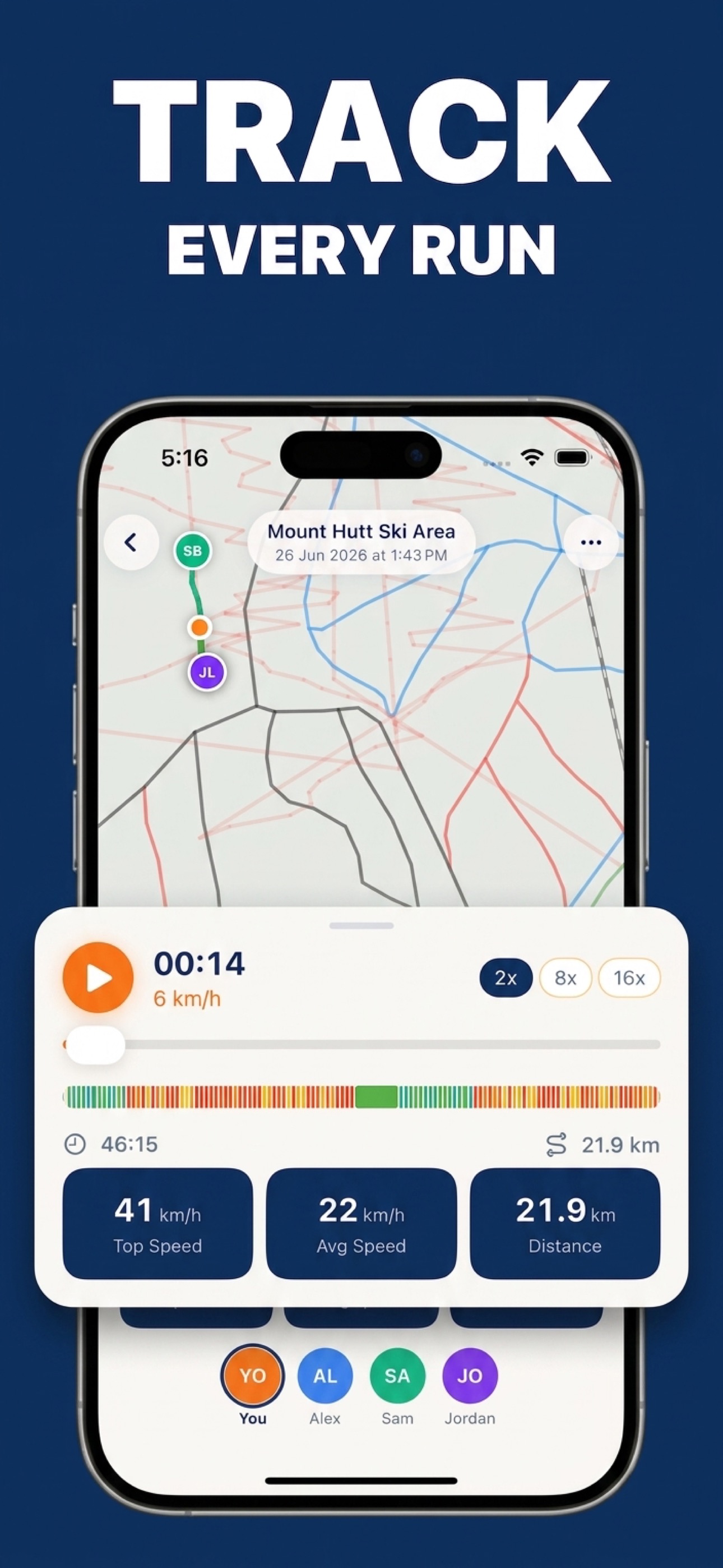
When you finish a run, the run summary presents your max speed and average speed front and centre alongside distance and vertical drop. These stats are calculated from the full GPS track, giving you an accurate picture of the entire descent.
For deeper analysis, the run replay feature lets you watch your track animated on the resort map with speed displayed at every point along the route. You can see exactly where you hit your top speed, where you slowed down, and how your pace varied across different sections of the run. Replay supports 2x, 8x, and 16x speed so you can scrub through quickly or watch in near real-time.
Over the course of a season, SnowRun tracks your all-time max speed in the season journal, so you can see your progression as your technique improves and you tackle steeper terrain. Your fastest run across all resorts is highlighted, giving you a clear personal record to beat.
Speed stats are part of the data you can share with friends and compare on group ski days. When skiing with a group, everyone’s top speeds from the day make for great après-ski conversation — and a little friendly competition.
See how fast you really ski
Real-time speed tracking, run replay, and season stats — all free.
Download SnowRun FreeFrequently Asked Questions
How accurate is GPS ski speed?
On open terrain with clear sky, phone GPS speed is typically accurate within 2–3 km/h. Accuracy decreases in dense tree cover or narrow valleys where satellite visibility is reduced. For recreational tracking, it’s more than sufficient to get a meaningful picture of your skiing.
Is there a speed limit at ski resorts?
Most resorts designate slow zones near lodges, lift loading areas, and trail merge points. These aren’t posted as specific speed limits but are marked with “Slow” signs. The universal rule is to always ski in control and be able to stop or avoid other people and obstacles.
How do I see my max speed?
Your max speed appears in the run summary screen after you stop recording. Your all-time season max is displayed in the Journal screen. You can also scrub through the run replay to see your speed at any point along your track.