How to Ski With Friends Without Getting Separated
The Group Skiing Problem
Skiing in a group should be one of the best parts of a mountain day. Friends, family, fresh snow, and shared stoke. But anyone who has tried to coordinate more than two people on a busy resort knows the reality: it is surprisingly easy to lose each other within minutes of stepping off the first lift.
The challenges start before you even click into your bindings. Groups almost always span different ability levels. A confident skier wants to hit the steeps while a beginner sticks to greens. Parents send kids off with an instructor and hope to reconnect at lunch. Teenagers disappear into the terrain park. Suddenly a group of eight is scattered across three different sectors of the mountain.
Meeting points sound simple in theory, but ski resorts are sprawling places. “Meet at the bottom of chair 6” works until you realize chair 6 has three possible unload points and the base area has two different lodges. Add in poor visibility on a cloudy day and even experienced locals can get turned around.
Then there is the communication problem. Cell signal at ski resorts is notoriously unreliable. Mountains create natural dead zones, and crowded resort infrastructure gets overloaded on peak days. You pull out your phone at the top of a run, see zero bars, and have no way to reach anyone. By the time you get signal at the base lodge, twenty minutes have passed and your group has scattered further.
Traditional Solutions (And Why They Fail)
Skiers have tried every workaround imaginable to keep groups together, and every one has significant drawbacks.
Meeting at the top or bottom. The most common approach: pick a lift and agree to meet at the top or bottom. This works for pairs, but with larger groups someone is always late, someone takes a wrong turn, and someone decides to do “just one more run” on a different lift. You end up standing in the cold for fifteen minutes, unsure whether to wait or go.
Walkie-talkies. A step up from nothing, but bulky and limited. Cheap consumer radios have a practical range of about half a mile in mountainous terrain — far less than the advertised range. They add weight to your jacket pocket, the batteries die in cold weather, and channels get crowded with other groups using the same frequency. Most people try them once and leave them in a drawer after that.
Phone calls and texts. When you have signal, phone calls work. But mountain dead zones mean calls drop mid-sentence and texts arrive in batches twenty minutes after they were sent. Group texts become a confusing stream of stale messages that no longer reflect where anyone actually is.
Apple Find My and similar apps. Location-sharing apps show a dot on a generic map. But a dot on a road map tells you almost nothing useful at a ski resort. Is your friend at the top of a lift or the bottom? Are they on a blue run or a black diamond? A generic map cannot answer these questions because it has no concept of ski runs, lifts, or lodge buildings. You see a dot in a green blob of mountain and have to guess.
Live Location Sharing on the Mountain
The solution is not just knowing where your friends are — it is knowing where they are in the context of the resort. A live dot on a ski map is fundamentally different from a dot on a road map. When you can see that your friend is halfway down Blue Bullet run, approaching the base of chair 4, you know exactly what that means. You know which lift to take to intercept them. You know whether they are five minutes away or twenty.
Real-time location on a resort map transforms group coordination from guesswork into glanceable information. Instead of calling, texting, and waiting, you pull up your phone and see the whole picture in two seconds. Your partner is at the lodge. Your kids are on the beginner slope with their instructor. Your friend who went ahead is already queuing for the next lift. Everyone is accounted for, no communication needed.
This is especially valuable for families with mixed abilities. Parents can let kids explore runs appropriate to their skill level while keeping a passive eye on their location. There is no need to hover or restrict where anyone goes — you can see them on the map whenever you want to check in. If someone takes a wrong turn or ends up somewhere unexpected, you spot it immediately rather than finding out an hour later.
The same applies to large friend groups. Different people can ski different terrain at their own pace, and everyone can regroup naturally by checking the map rather than trading phone calls. When you see three friends converging at the mid-mountain lodge, you know that is a good time to head there yourself.
How SnowRun Helps
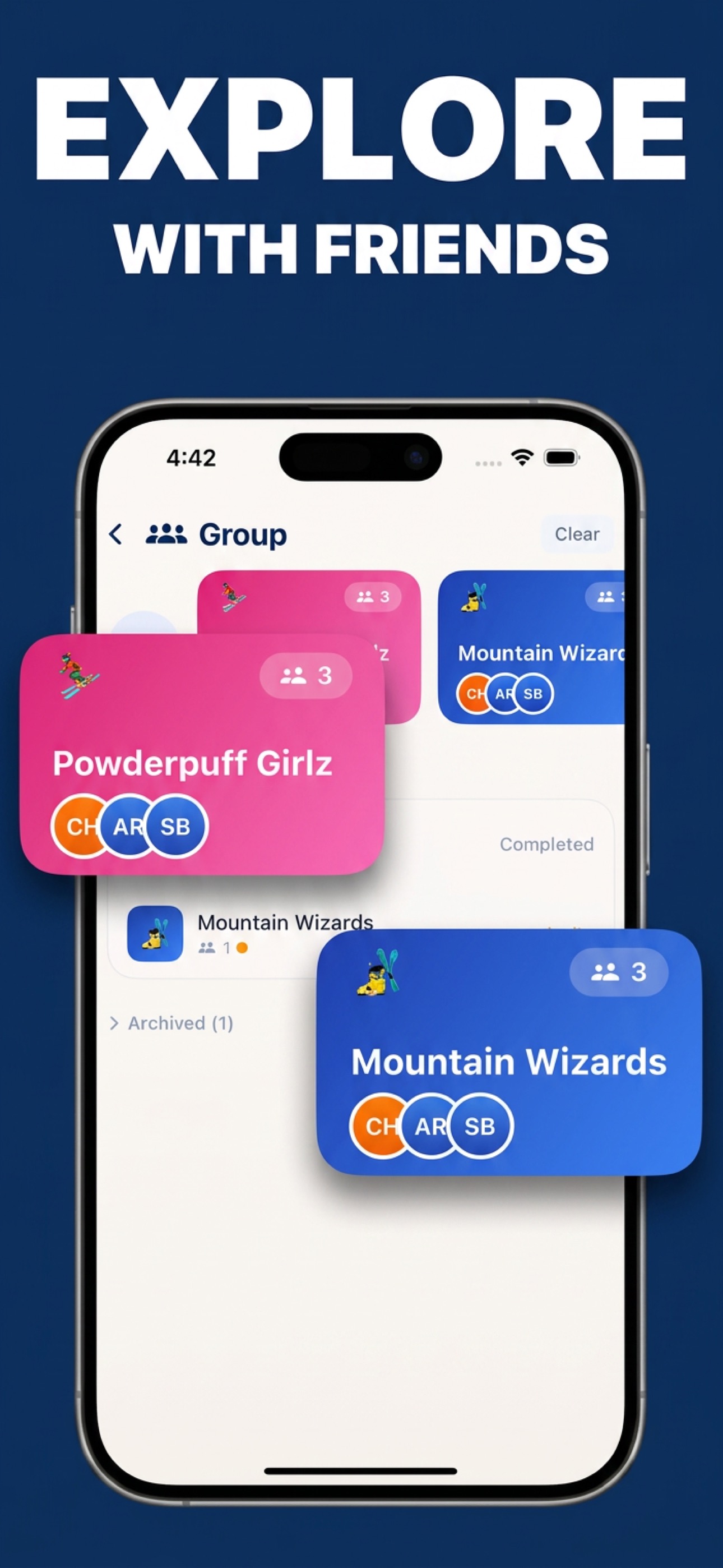
SnowRun’s group run feature is built specifically for this problem. Starting a group run takes a single tap from the map screen. You get a shareable link that you send to your friends via text, AirDrop, or any messaging app. When they tap the link, they join your group — no account creation required for basic tracking.
Once a group run is active, every member appears as a live dot on the resort map. Not a generic map — the actual resort map with every run, lift, lodge, and terrain feature labeled. You can see at a glance:
- Which run or lift each person is on
- Whether they are moving or stationary (waiting at a lift, sitting in the lodge)
- How far they are from your current position
- Their general direction of travel
The feature works across skill levels because it does not require everyone to ski together. A group of eight can split into three sub-groups hitting different parts of the mountain, and everyone still sees everyone on the map. Regrouping happens naturally — when you spot someone nearby, you ski over to join them.
While the group run is active, SnowRun automatically records all of each member’s individual runs in the background. At the end of the day, every person has a complete journal of their runs with speed, distance, and vertical stats — no extra setup required. The group run handles the social coordination while individual tracking runs quietly underneath.
For families, this means parents get peace of mind without being overbearing. For friend groups, it means maximum freedom with zero coordination overhead. No walkie-talkies, no meeting-point confusion, no shouting into phones with no signal. Just open the app, glance at the map, and ski.
Never lose your crew on the mountain again
Start a group run and keep your whole squad connected on the resort map.
Download SnowRun FreeFrequently Asked Questions
Can I see my friends on the ski map?
Yes. When a group run is active, every member appears as a live dot on the resort map. You can see which run or lift they are on and how far they are from you, all in real time.
How many people can join a group run?
Multiple members can join a single group run. Just share the invite link and anyone who taps it joins the session and appears on the map.
Does group tracking use mobile data?
Live location sharing requires a data connection to send and receive positions. Your own GPS tracking works offline using satellite signals, but seeing other group members’ locations in real time needs cell data or Wi-Fi.